顯示包含「space」標籤的文章。顯示所有文章

2025年11月23日星期日

[Space] About 3I/ATLAS' Mass Loss of 5 Billion Tons a Month

An article has reported that Harvard astrophysicist Avi Loeb suggested comet 3I/ATLAS is losing about 5 billion tons of mass per month, possibly due to “technological thrusters pointing toward the Sun.” NASA quickly countered, stating it is a natural interstellar comet. The debate has sparked scientific and public controversy, with NASA confirming the comet shows non‑gravitational acceleration but attributing it to natural cometary processes/


Background of 3I/ATLAS
Discovery: 3I/ATLAS was first detected in July 2025 by the ATLAS telescope in Chile.

Nature: It is the third confirmed interstellar object to enter our solar system, after ʻOumuamua (2017) and 2I/Borisov (2019).

Trajectory: Its orbit is hyperbolic, meaning it is not bound to the Sun and will eventually leave the solar system.

Speed: At perihelion (closest approach to the Sun), it reached speeds of 153,000 mph (68 km/s).

Scientific Value: Offers a rare chance to study material formed around another star system ~7 billion years ago.

Images: NASA and international observatories have released multiple images showing its coma and tail, confirming cometary behavior.

Detailed background on Wikipedia.

Observations & Speculation About “Spaceship” Theories
While mainstream science identifies 3I/ATLAS as a comet, some unusual features have fueled speculation:

Avi Loeb’s Claim: Suggested its mass loss and trajectory could be consistent with artificial propulsion.

NASA’s Response: Officials firmly reject alien spacecraft theories, stating “it looks and behaves like a comet”.

Public Speculation: Online discussions compared it to ʻOumuamua, with some conspiracy theories suggesting it might be a probe.

Scientific Debate: Physicist Michio Kaku dismissed the alien hypothesis, calling it a “cosmic relic” rather than engineered technology.

Unusual Tail: Observations show a complex, changing tail structure, which some enthusiasts interpret as evidence of artificiality, though astronomers attribute it to natural outgassing.

Academic Papers: A few speculative studies (e.g., Loeb et al. draft, arXiv preprint) explore the possibility of technological origins, but these remain fringe ideas.

3i/ATLAS Updates, 11/23/2025 by Beyond Orbit:


China Finally Shows First Real Image of 3i/ATLAS


James Webb Just Recorded Something Unprecedented with 3iATLAS 11/23/2025 by Cold Veil Chronicles




2025年11月22日星期六

[Space] Moon's Helium-3

Helium‑3 is a rare, stable isotope of helium with two protons and one neutron, first isolated in 1939 after being proposed by physicist Mark Oliphant in 1934. Unlike the more common helium‑4, it is fermionic and exhibits unique quantum properties such as becoming a superfluid at extremely low temperatures. On Earth, helium‑3 is scarce, occurring in trace amounts in the atmosphere, mantle, and natural gas deposits, and is mainly produced through the radioactive decay of tritium. However, it is thought to be more abundant on the Moon, where solar wind has implanted it into the regolith over billions of years, and in the atmospheres of gas giants. Its potential as a clean nuclear fusion fuel—because helium‑3 fusion reactions produce little to no harmful neutron radiation—has made it a subject of scientific and geopolitical interest, though practical extraction and use remain technologically and economically challenging

The new mineral discovered on the Moon, named Changesite- (Y), was identified by Chinese scientists from lunar samples collected during the Chang'e-5 mission. This mineral is a phosphate with a chemical formula of (Ca8Y)□Fe2+ (PO4)7, forming colorless, transparent columnar crystals in basalt particles. It was first identified by researchers at the Beijing Research Institute of Uranium Geology and is the sixth new lunar mineral to be found. Changesite- (Y) is significant as it contains helium-3, a rare isotope that could be used in nuclear fusion, potentially providing a clean energy source for future generations.

Timeline of Helium‑3
1934 – Australian physicist Mark Oliphant first proposed the existence of Helium‑3 while experimenting with nuclear reactions at Cambridge’s Cavendish Laboratory.

1939 – Luis Alvarez and Robert Cornog successfully isolated Helium‑3, proving it was a stable isotope rather than radioactive.

1972 – Researchers published the discovery of superfluid Helium‑3, showing that unlike bosonic Helium‑4, it behaves as a fermion and enters a superfluid state at millikelvin temperatures.

Late 20th Century – Helium‑3 became recognized as a byproduct of tritium decay in nuclear reactors, making it available in small industrial quantities.

2000s–Present – Interest grew in Helium‑3 as a potential fusion fuel due to its aneutronic reactions (producing little radioactive waste). Scientists also highlighted its scarcity on Earth but relative abundance on the Moon’s regolith and in gas giant atmospheres.

2025 – Pulsar Helium Inc. announced a terrestrial discovery of Helium‑3 in Minnesota, sparking renewed attention to Earth‑based recovery alongside lunar mining ambitions.

Helium-3: The Moon’s Hidden Super Fuel—and China Is Closer Than Anyone
Helium-3: The Future Energy Source on the Moon

2013年11月6日星期三

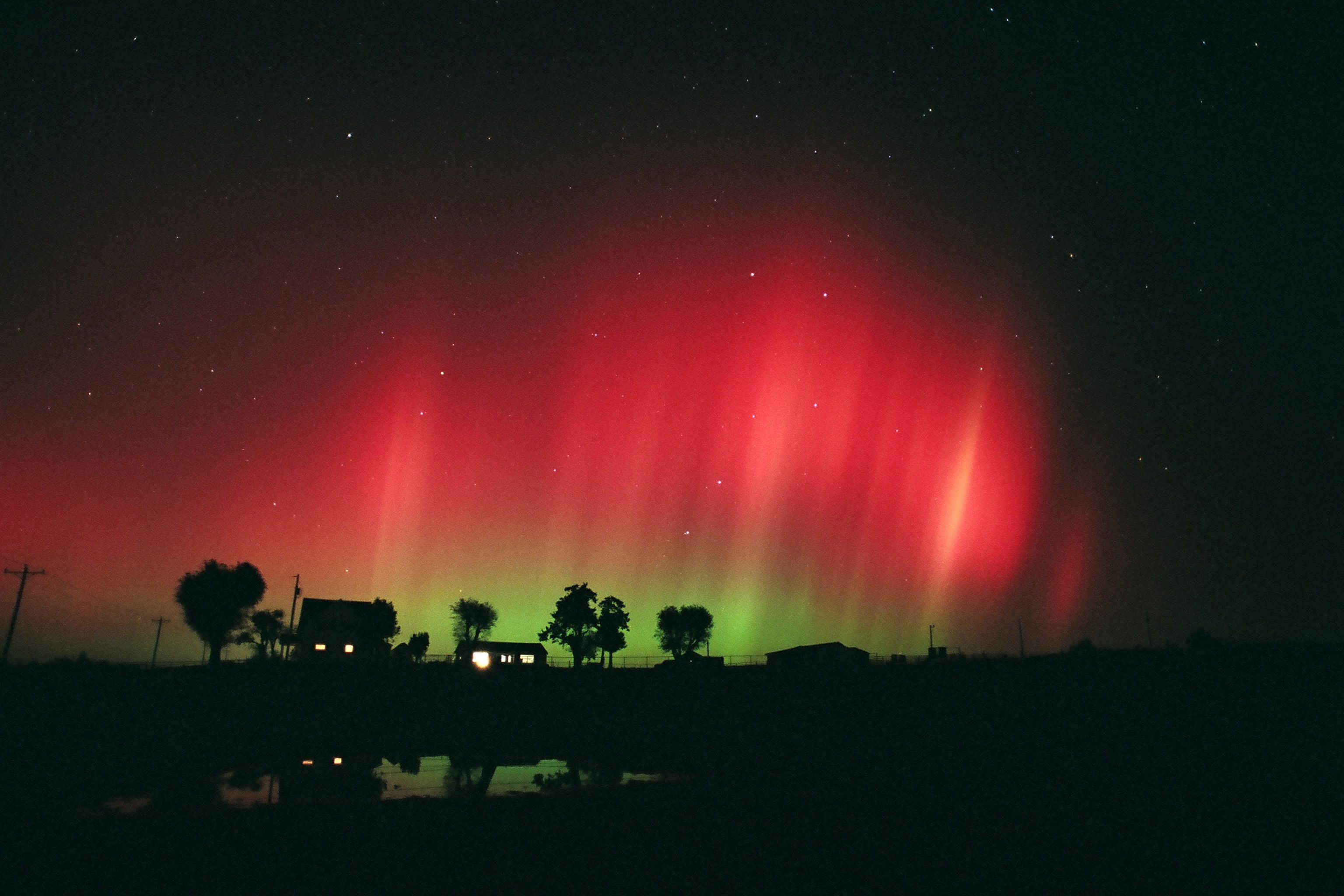
北極光 Northern Lights

The northern lights are caused by collisions between fast-moving particles (electrons) from space and the oxygen and nitrogen gas in our atmosphere. These electrons originate in the magnetosphere, the region of space controlled by Earth’s magnetic field. As they rain into the atmosphere, the electrons impart energy to oxygen and nitrogen molecules, making them excited. When the molecules return to their normal state, they release photons, small bursts of energy in the form of light. [1]

[Google Translate:] 北極光的快速移動的粒子(電子從空間我們大氣中氧和氮的氣體之間的碰撞所造成的這些電子起源於磁層地球磁場控制的空間區域下雨到大氣中,因為它們電子傳遞氧和氮分子能量使它們激發分子恢復到正常狀態他們釋放光子爆發的能量以光的形式

Astronaut Mike Hopkins, aboard the International Space Station, shared this picture of the northern lights on Oct. 9, 2013, saying "The pic doesn't do the northern lights justice. Covered the whole sky. Truly amazing!": [1]

[Google Translate:] 登上國際空間站宇航員邁克·霍普金斯大學,分享這幅畫2013年10月9日北極光PIC不會北極光正義覆蓋了整個天空真正驚人


---------------------------------------------------------------------------------------------------------------------------
IMAGE SEARCH - NORTHERN LIGHTS

Link: http://apod.nasa.gov/apod/image/0311/auroraOK_ewoldt_f1.jpg

Link: http://apod.nasa.gov/apod/image/0208/aurperseids_clark_full.jpg


Link: http://www.earthobservatory.nasa.gov/Features/GreenlandBlogKoenig/images/greenland_aurora.jpg

Video:

Aurora Borealis (Northern Lights). Time lapses in Norway. Polarlichter. Der Himmel brennt.


----------------------------------------------------------------------------------------------------------------------
[1] http://www.nasa.gov/content/northern-lights-viewed-from-the-international-space-station/#.UnrFPxCBmbc

2013年10月31日星期四

Happy Halloween - 'Witch Head' Brews Baby Stars 快樂萬聖節 - 女巫頭星群嬰兒恆星

'Witch Head' Brews Baby Stars 
 
 
A witch appears to be screaming out into space in this new image from NASA's Wide-Field Infrared Survey Explorer, or WISE. The infrared portrait shows the Witch Head nebula, named after its resemblance to the profile of a wicked witch. Astronomers say the billowy clouds of the nebula, where baby stars are brewing, are being lit up by massive stars. Dust in the cloud is being hit with starlight, causing it to glow with infrared light, which was picked up by WISE's detectors.
The Witch Head nebula is estimated to be hundreds of light-years away in the Orion constellation, just off the famous hunter's knee.

WISE was recently "awakened" to hunt for asteroids in a program called NEOWISE. The reactivation came after the spacecraft was put into hibernation in 2011, when it completed two full scans of the sky, as planned.

Google Translate 谷歌翻譯:

一個巫婆出現尖叫在這個新形象進入太空美國宇航局的寬視野紅外巡天探測器或明智紅外線畫像顯示女巫頭星雲,它的相似而得名一個壞巫婆檔案天文學家說,洶湧雲彩星雲嬰兒恆星正在醞釀質量恆星點燃了星光在雲中塵埃被擊中使其煥發出紅外光,WISE探測器被拾起

女巫頭星雲的估計是幾百光年獵戶星座,只是關閉了著名獵人的膝蓋

最近被驚醒追捕小行星名為NEOWISE程序激活來到飛船進入休眠狀態,按計劃在2011年,當它完成兩個完整的天空掃描


Image credit: NASA/JPL-Caltech
-------------------------------------------------------------------------------------------------------------------------

Dr Seuss - Halloween is Grinch Night 

蘇斯博士 - 萬聖節之夜聖誕怪傑